Choosing the wrong ecommerce CRO agency can set your brand back months, while the right one compounds growth quarter after quarter. We've seen luxury brands turned into discount machines by agencies that applied the same generic playbook they use for SaaS companies and lead gen funnels, chasing quick conversion wins that erode the brand equity you spent years building.
This guide breaks down what separates elite CRO partners from test-runners, based on patterns we've seen across hundreds of 8-9 figure DTC engagements. You'll learn the evaluation criteria that brands like Hyperice and Laura Geller use to select CRO partners who balance revenue growth with brand protection, and the red flags that predict failure before the first test even launches.
Why ecommerce CRO requires specialized expertise
The patterns that convert an $80 skincare buyer are completely different from what works in SaaS or lead gen, yet most CRO agencies apply the same playbook across all verticals. This mismatch is the single biggest source of failed CRO engagements at 8-9 figure brands.
DTC buyers make decisions differently from B2B or SaaS buyers
DTC ecommerce buyers make emotionally-driven, identity-based purchasing decisions. A skincare customer isn't just buying a moisturizer. She's buying into a brand promise, a lifestyle signal, and a community. Tactics that work for SaaS trial signups (urgency banners, aggressive pop-ups, friction-reduction at all costs) actively undermine the premium positioning that justifies a $90 price point.
Generalist agencies also misread the role of product differentiation in high-SKU categories. Consider a beauty brand with dozens of moisturizers, cleansers, and serums across different skin tones, concerns, and lifestyles. An agency without category experience may optimize for click-through without realizing that reassurance and skin-match confidence are the actual conversion levers. They optimize the wrong thing, and the metrics look fine until revenue stalls.
Brand protection matters more at 8-9 figures
At 8-9 figures, your brand perception directly determines your pricing power. A 5% conversion lift that trains customers to expect 30% discount pop-ups is a net negative, because it erodes the brand equity that took years to build. Elite CRO agencies understand this trade-off explicitly and build it into their testing frameworks.
The agencies that damage premium brands the most are those that treat every test winner as a permanent implementation. A test winner in a two-week window can still be a long-term brand liability. Specialized ecommerce CRO agencies have frameworks for evaluating test results against brand health indicators, not just conversion metrics in isolation.
How to choose an ecommerce CRO agency
Over the last several years, the number of agencies providing CRO or landing page services has grown exponentially. While you have no shortage of options, it's all too easy to choose the wrong one. After interviewing dozens of 8-9 figure brands about their CRO partner selection, three criteria consistently separate successful engagements from failures: research methodology depth, category-specific experience, and process maturity.
Before you shortlist anyone, run every agency through the same checklist. Score them on what predicts the outcome, not the polish of the pitch:
Research depth: can they walk you through a named research process, with deliverables, before the first test launches?
Category experience: have they worked in your category at your price point, and can they name the specific friction they hit?
Process maturity: can they tell you what happens in months one, two, and three, or do they default to "running tests"?
Brand protection: do they have a framework for when a test winner conflicts with brand guidelines, and will they recommend against shipping one?
Traffic and maturity fit: are you at the level where testing can reach significance, roughly $10M+ and enough orders to read a result in weeks, not quarters?
Proof that matches you: are their case studies in your category and revenue stage with specific outcomes, not enterprise logos from unrelated verticals?
Research methodology depth is the single best predictor of agency quality
The most reliable way to evaluate a CRO agency is to ask one question: "Walk me through your research process before the first test launches." Weak agencies describe tools: heatmaps, session recordings, and Google Analytics. Elite agencies describe a structured methodology with named stages and clear deliverables.
One framework that exemplifies this approach is what we call the 3Ps: Patterns (quantitative data analysis to identify where revenue is leaking), Perception (qualitative research to understand why visitors aren't converting), and Proof (hypothesis development and test design grounded in both). Agencies that jump straight to testing without this foundation are running borrowed winners from other brands, and borrowed winners fail because your customers, your brand, and your category are not interchangeable.
Be mindful of agencies that rely heavily, or even solely, on "best practices." While CRO strategies that have worked for other ecommerce brands can be useful when brainstorming solutions, they shouldn't be the foundation of your conversion rate optimization strategy. Any CRO agency worth talking to will insist on developing a customized approach based on what is or isn't currently working for your business.
Category-specific experience separates good advice from dangerous advice
There is no one-size-fits-all approach to CRO, and the consequences of generic advice get more expensive as your brand scales. Category experience matters most in regulated industries and high-consideration purchase categories. Supplements and FDA-constrained wellness brands face claim restrictions that a generalist agency will violate without realizing it. Luxury and beauty brands have brand voice standards that an agency without premium DTC experience will casually override in pursuit of a conversion lift.
Consider skincare and beauty brands with dozens of moisturizers, cleansers, and serums. Because these brands talk about many different skin tones and shades, skin issues, and even lifestyle choices, reassurance is needed to drive conversions. An agency without industry expertise may not realize things like this, which would stunt the potential of the CRO strategies they put together.
An agency that has "done this before" in your category navigates landmines you don't even know exist. During discovery calls, ask for specific examples of category-specific challenges they've encountered and how they resolved them, not generic case studies, but specific friction points unique to your product type.
Process maturity shows up in how an agency talks about timelines
Process maturity is the difference between an agency that can articulate what happens in months one, two, and three and an agency that defaults to vague language about "running tests" and "iterating." Mature agencies have documented onboarding processes, defined research phases with clear outputs, and structured test prioritization frameworks.
Immature agencies (regardless of how polished their pitch deck is) cannot tell you what research deliverables you'll receive before testing begins, because they don't have a research phase. They go straight to testing, which means they're guessing with your revenue.
Cost isn't just about price; it's about what you're paying for
The cost of CRO agencies varies widely, so don't narrow your search solely to your ideal budget. Consider each agency's level of expertise, which can directly impact your potential return on investment for better or for worse. You'll also need to determine which fee structure works best for you (e.g., an hourly project fee or a monthly retainer).
Watch out for incentive-based pricing structures that promise a certain number of tests per month. Testing is important, of course. But a good agency will be more concerned with running the right types of tests for your business, not just running tests because they need to hit a quota.
What to look for in a CRO agency for subscription brands
If most of your revenue rides on auto-ship, subscribe-and-save, or membership, you're evaluating for a different job than a one-time-purchase brand is.
A generalist agency will optimize your conversion rate, report a win, and leave the metric that pays your bills, how many buyers pick the subscription, untouched. Before you sign anyone, press on three things.
They optimize for lifetime value, not just conversion rate
For a subscription brand, revenue per visitor tells only half the story.
Two customers can spend the same on their first order, but one re-orders for a year and the other never comes back, so first-order revenue hides the gap that matters most.
The number a good partner watches instead is the subscription opt-in rate at the buy box: the share of buyers who choose auto-ship over a one-time purchase. Move that a few points, and you've changed the economics of the whole business without touching traffic.
Ask a prospective agency what they'd measure beyond CVR and AOV.
You want to hear the subscription opt-in rate, retention, and churn by monthly cohort, and lifetime value broken out by entry offer, since an intro pack behaves very differently from a full subscription started on day one.
If they can't name those, they're going to run one-time-purchase plays on a business that doesn't work that way.
The buy box is the surface that decides the outcome
For these brands, the buy box on the product page is the funnel.
It's where the subscribe-versus-one-time decision gets made, and it's the single highest-leverage spot on the site, yet it's the surface most agencies leave alone because it's harder to test than a headline or a hero image.
We've seen subscription-first brands come to us after months with another agency where the opt-in rate hadn't moved a single point, because nobody had touched the buy box.
So ask what they've tested there. Real answers sound like: default selection (sub or one-time), how the discount is framed (a percentage versus a dollar amount versus a per-day cost), where the subscription option sits relative to one-time, and how flexibility gets communicated, since survey data repeatedly points to fear of lock-in as the top reason people won't subscribe. "Cancel anytime, skip or pause whenever" often does more work than a bigger discount.
One caution worth raising with any agency: a subscription lift has to be net-positive after you account for the one-time revenue it eats.
They treat the entry offer as the acquisition strategy
The most common mistake we see is brands bolting subscription on as an afterthought.
They sell the product once, then email a week later asking the customer to subscribe. One supplement founder we spoke with called their own version of this setup "atrocious," and it's the default at a surprising number of DTC brands. By the time that email goes out, most of the lifetime value is already gone.
For a subscription business, the first-purchase offer is the acquisition strategy, so it belongs at the front of the experience, not in a follow-up flow.
A capable partner designs and tests that entry moment: intro pack versus discounted first cycle versus a subscription started up front, and which one produces the best retention down the line, not just the easiest first sale.
A last practical point: the tooling has to see profit, not just conversions.
We run subscription tests through platforms that sync with the brand's subscription app and cost data, so we can tell whether a test moved subscription share and margin together, rather than lifting opt-ins while quietly eroding profitability.
Ask any agency how they measure the profit impact of a subscription test. If the answer stops at conversion rate, keep looking.
The 5 best ecommerce CRO agencies
These five agencies have proven track records with 8-9 figure DTC brands, but each excels in different scenarios. Match your specific situation (category, revenue stage, internal capabilities, and primary growth constraint) to the agency profile that fits.
1. SplitBase
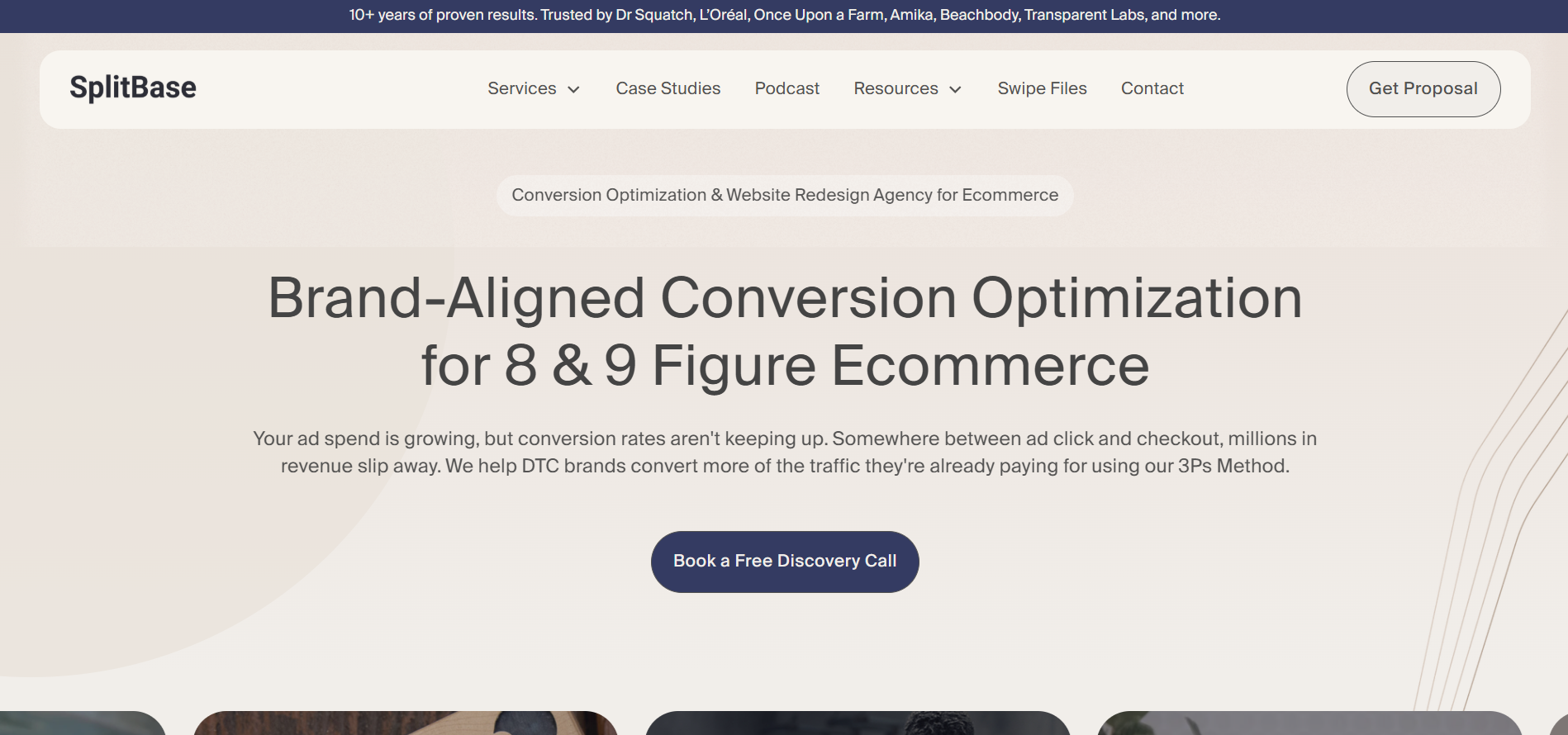
SplitBase is the agency of choice for premium DTC brands on Shopify that need CRO grounded in deep customer research rather than test libraries. Our entire team (copywriters, designers, and developers) specializes exclusively in conversion optimization for ecommerce, which means every implementation decision is evaluated through a CRO lens rather than bolted onto a broader digital marketing service offering.
The core methodology is the Testing Trifecta: quantitative data analysis to identify what's underperforming, qualitative research to understand why, and hypothesis-driven A/B testing informed by both. This sequence is non-negotiable. We don't skip to testing before the research foundation is established, and that discipline is what produces durable results rather than one-time spikes.
What sets this approach apart is what happens before the first test launches. We always start by digging into quantitative data, such as analytics for your Shopify store, to identify its strengths and weaknesses. Then, we move on to the collection and analysis of qualitative data, such as customer feedback. This tells us why certain elements of your online store and user experience are helping or hurting your conversion rate.
Only once we know what's not working and why (or what strengths are worth leaning into) do we develop hypotheses on what to A/B test. After all, it's a lot harder and more time-consuming to come up with solutions if you don't know what's wrong in the first place.
And in supplements, where claim restrictions trip up agencies that don't know the category, we ran a year-long program with Transparent Labs that grew subscription take rate from 22% to 38%+ and lifted average conversion rate by over 12%, worth seven figures in monthly revenue.
Conversion-focused web design: beautiful Shopify ecommerce websites designed for functionality, increasing average order value, driving conversions, and boosting revenue
User experience and conversion research: analytics, usability testing, and qualitative research deep dives to identify friction points and conversion opportunities
Best for: Premium DTC brands on Shopify in fashion, skincare, beauty, and lifestyle categories at $10M+ revenue.
Key differentiator: Research-first methodology with brand protection built into the testing framework.
Notable clients: Amika, Butcher Box, Kiehl's, L'Oréal, and Dr. Squatch.
Pricing: Full-service CRO programs start at $8,500 per month.
2. Conversion
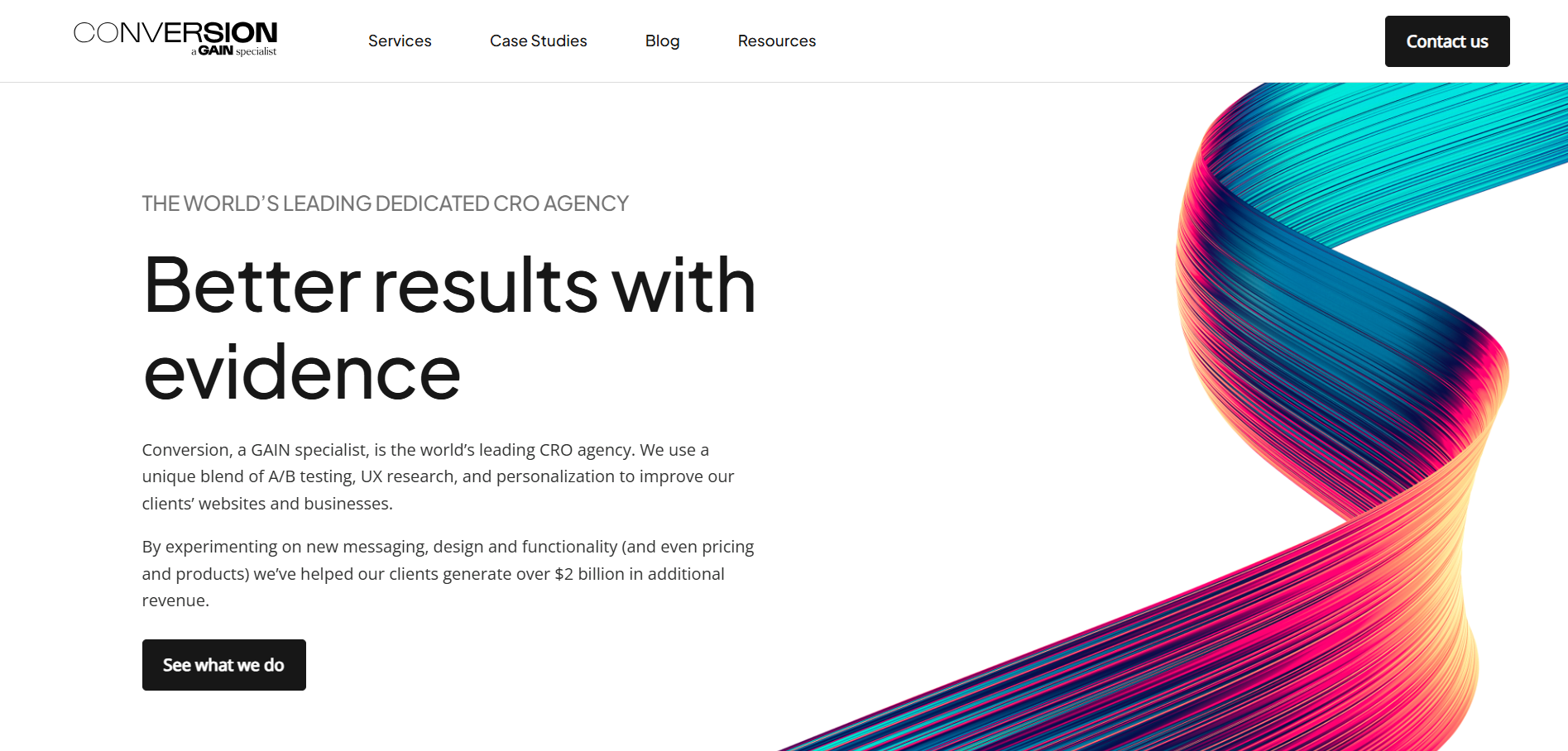
Conversion is a global CRO agency with over 100 employees across Europe and North America, serving enterprise, ecommerce, and SaaS organizations. Their breadth of service, from split testing and personalization to pricing experimentation and enterprise program consulting, makes them a strong fit for large organizations that need to build internal CRO capabilities alongside external execution.
Their user experience research (UXR) practice is a particular strength, providing the "why" behind customer behavior that informs more sophisticated personalization strategies. For brands that want to eventually bring CRO in-house, Conversion's enterprise consulting and internal stakeholder training programs offer a structured path to that transition.
Key services:
Conversion rate optimization through split testing and iterative experimentation
Personalization based on customer needs research
Product and pricing experimentation
User experience research (UXR) to explain the "why" behind customer behavior
Enterprise program consulting and in-house CRO capability building
Best for: Enterprise ecommerce brands that need both execution and internal capability building.
Notable clients: Microsoft, Facebook, Google, Toyota, Canon, and Samsung.
Pricing: Not publicly available.
3. Structured
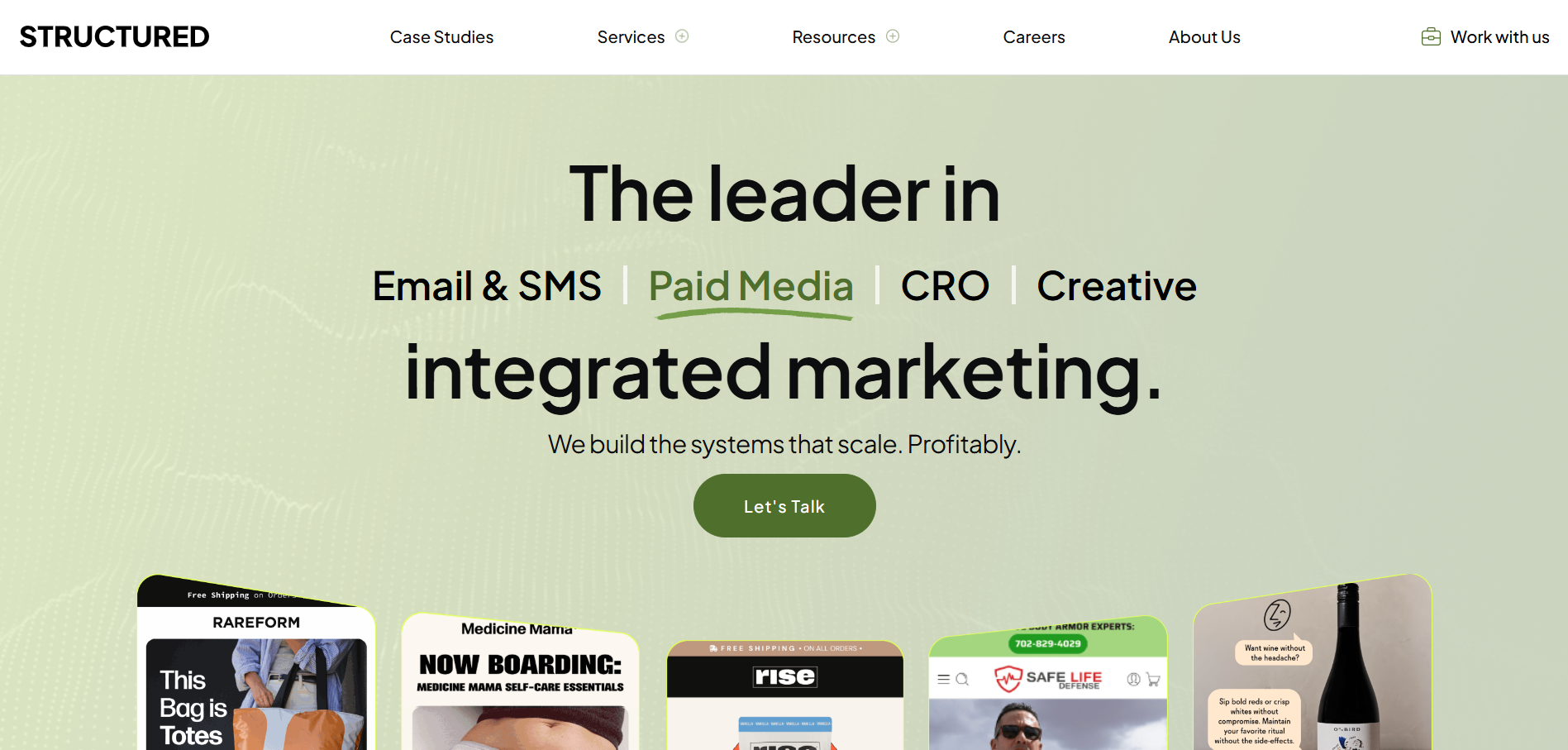
Structured is a performance marketing agency with over 15 years of experience and 150+ brand relationships, specializing in health and wellness, sports and outdoors, pets, food and beverage, and apparel. Their CRO services are integrated with paid media, email, SMS, and content creation, making them a strong fit for brands seeking a single agency to manage the full acquisition-to-conversion funnel.
The integration between paid media and CRO is Structured's primary differentiator. When the same agency controls both ad creative and landing page optimization, the feedback loop between traffic quality and conversion performance tightens significantly. For brands where paid media is the primary acquisition channel, this integration can eliminate the coordination overhead that slows down testing velocity.
Key services:
CRO services combining UI and UX design
Email and SMS marketing campaigns
Paid media campaigns across TikTok, Facebook, Instagram, and Google Ads
Content creation, including photography, video production, and user-generated content sourcing
Best for: Brands that want paid media and CRO managed under one roof, particularly in health, wellness, and outdoor categories.
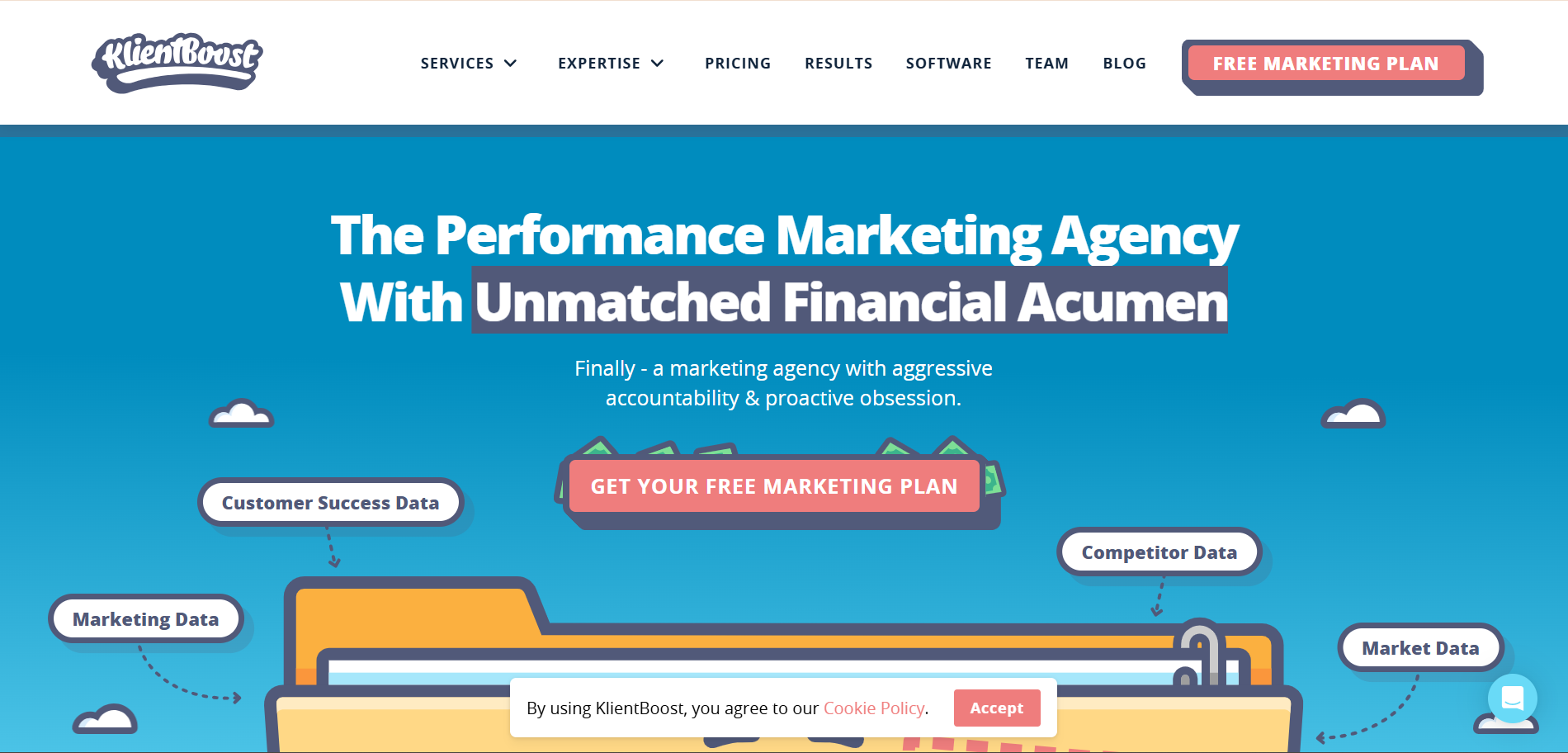
KlientBoost is a performance marketing agency with 250+ clients, offering CRO as part of a broader suite of paid advertising and SEO services. Their CRO offering includes one-time audits, ongoing consulting, and full management, giving brands flexibility in how deeply they engage. The revenue-split partnership model aligns agency incentives with client outcomes, reducing the risk that agencies run tests for volume rather than impact.
KlientBoost's strength is landing page optimization tied directly to paid campaign performance. For brands running significant spend on Facebook, Google, and LinkedIn, their ability to connect ad creative strategy with landing page testing creates measurable improvements in cost per acquisition. Their CRO practice is strongest when paired with their paid media management.
Key services:
CRO through A/B testing and landing page design for every campaign type
Paid advertising across Facebook, Google, LinkedIn, and other channels
SEO and content marketing strategy with link-building services
Email marketing strategy development and execution
Best for: Brands with significant paid media budgets that want CRO integrated with campaign management.
Notable clients: Airbnb, Gorjana, Upwork, Hotjar, and Wunderkind.
Pricing: Revenue-split partnership model. Prospective clients can complete a questionnaire on the company's website and receive three pricing options.
5. Single Grain
Single Grain is a full-service digital marketing agency serving ecommerce brands, SaaS companies, and online education providers. Founded in 2014 and originally an SEO agency, Single Grain has expanded into a comprehensive growth marketing partner covering CRO, content marketing, and paid advertising across all major channels.
Their CRO approach combines qualitative customer research with continuous A/B testing iteration, and their findings feed directly into landing page design and site optimization. For brands that need a single agency to manage SEO, content, paid media, and CRO simultaneously, Single Grain's integrated service model reduces vendor management complexity.
Key services:
Conversion rate optimization using qualitative data, customer research, and A/B testing
Content marketing strategy, including blog posts, ebooks, email campaigns, and case studies
Paid advertising across Facebook, Instagram, TikTok, YouTube, Amazon, and Google
Best for: Brands that need a full-service growth marketing partner with CRO as one component of a broader strategy.
Notable clients: Amazon, Nordstrom Rack, Peet's Coffee, Fujitsu, and Hestan.
Pricing: Not publicly available.
Red flags that predict CRO agency failure
Multiple brands report these three patterns before the first test even launches. Recognizing them during the pitch process saves months of wasted engagement and protects your brand from damage that's harder to reverse than a revenue dip.
"Best practice" test libraries are a substitute for thinking, not a strategy
The most common red flag is an agency that leads with a library of "proven tests" from other brands. Best practices are useful for brainstorming. They are not a substitute for research. What converts visitors for a $40 supplement brand will not necessarily convert visitors for a $150 skincare brand, even if the product categories seem adjacent.
Borrowed winners fail because they're built on someone else's customer psychology, brand positioning, and traffic mix. When an agency pitches you a list of tests they've "already validated," they're telling you they plan to run their playbook on your brand rather than develop a strategy grounded in your specific data. Ask directly: "How many of these tests are based on research specific to our brand versus results from other clients?" The answer will be revealing.
Conversion-only focus creates damage that compounds over time
Agencies that optimize exclusively for conversion rate without accounting for brand health create a specific type of damage that gets worse month after month. The most common manifestation is discount dependency: aggressive pop-ups and urgency tactics that lift short-term conversion rates while training customers to expect discounts, undermining full-price purchasing behavior and eroding margin.
A related pattern is brand voice degradation. Agencies without premium DTC experience will rewrite copy to be "more direct" or "clearer" in ways that strip out the brand personality that justifies premium pricing. The copy performs better during a two-week test window but damages brand equity over the following year. Ask agencies how they've handled situations where a test winner conflicted with brand guidelines. The quality of that answer separates brand-aware agencies from conversion-only operators.
Limited category experience shows up in painful ways
Category inexperience shows up most painfully in regulated industries and high-consideration purchase categories. An agency without supplement or wellness experience will write claims that violate FDA guidelines, not out of negligence but out of genuine ignorance of the constraint. An agency without luxury or beauty experience will apply urgency tactics that cheapen the brand experience, in ways immediately visible to your core customer.
During pitches, ask for specific examples of category challenges they've navigated, not general ecommerce experience, but challenges specific to your product type, price point, and customer psychology. Agencies with genuine category depth will have specific stories. Agencies without it will generalize.
CRO agency pricing and what to expect
Expect to invest $15-50K per month for legitimate CRO expertise at an 8-9 figure scale, with engagement models varying by agency maturity. The wide range reflects differences in scope, team size, and the depth of research included in the engagement.
At the lower end of the range ($15-20K per month), engagements typically include a research phase, test prioritization, and ongoing A/B testing with monthly reporting. At the higher end ($35-50K per month), engagements include deeper qualitative research, personalization strategy, multivariate testing programs, and dedicated team resources. SplitBase's full-service programs start at $8,500 per month for brands earlier in their CRO journey.
Six-month minimums are standard because proper CRO requires a research phase before testing begins (typically 4-6 weeks), followed by test design, implementation, and statistical validation. Agencies offering month-to-month engagements are signaling that they skip the research phase and rely on test libraries, which is a red flag in itself. Expect 3-4 months to see statistically significant results from initial tests.
The most common engagement models include:
Retainer model: Most common for ongoing optimization programs. Includes research, testing, and reporting on a monthly basis. Best for brands committed to continuous improvement.
Project model: Suitable for specific initiatives like site redesigns, landing page builds, or one-time CRO audits. Limited ongoing value without a testing program to follow.
Revenue-share model: Aligns agency incentives with outcomes. Requires a clear attribution methodology to avoid disputes. Best when both parties have high confidence in the measurement infrastructure.
Hybrid model: Retainer base with performance bonuses. Balances predictable agency economics with outcome alignment.
A 15-30% revenue-per-visitor improvement in year one is realistic for most 8-9-figure brands with a research-driven CRO program. Larger gains usually indicate previous neglect of optimization rather than exceptional agency performance. Sustainable growth from systematic testing beats one-time spikes from high-risk tests every time.
Making your CRO agency decision
The right CRO agency decision comes down to matching your specific situation (revenue stage, category, internal capabilities, and primary growth constraint) to the agency profile that fits. Use the discovery call to surface the information that matters, not to evaluate polish.
Questions worth asking in discovery calls
Walk me through your research process before the first test launches. What specific deliverables will we receive?
Tell me about a test that failed. What did you learn, and how did it change your approach?
How have you handled a situation where a test winner conflicted with brand guidelines?
What's your experience in our specific category? What are the conversion challenges unique to brands like ours?
How do you prioritize which tests to run? Walk me through a real prioritization decision.
What does the first 90 days look like in terms of deliverables and milestones?
Proof points that matter
Evaluate agencies on the specificity and relevance of their proof points, not the impressiveness of their client logos. A case study from a brand in your category at your revenue stage is worth 10 times as much as a case study from an enterprise brand in an unrelated vertical. Ask for results that are comparable to your situation: same category, similar price point, similar traffic volume.
Client references are more valuable than case studies because they reveal the working relationship, not just the outcome. Ask references specifically about the research phase, how the agency handled tests that didn't perform, and whether they'd re-engage the agency. The answers to those questions reveal more about agency quality than any metric in a pitch deck.
Frequently asked questions
How do we know if we need a specialized ecommerce CRO agency vs. a generalist?
If you're above $10M revenue and brand perception directly impacts your pricing power, you need ecommerce specialization. Generalist agencies often damage premium positioning by applying B2B or lead gen tactics that cheapen the brand experience. The higher your price point and the more brand-dependent your conversion rate, the more category specialization matters.
What's the typical ROI timeline for a CRO agency engagement?
Expect 3-4 months to see statistically significant results from initial tests. Agencies promising immediate 50% lifts are likely running high-risk tests that can damage brand equity. Sustainable growth comes from research-driven testing, and the research phase alone typically takes 4-6 weeks before the first test launches.
Should we hire an agency that also handles our paid media?
Only if CRO is their primary expertise. Many performance marketing agencies bolt on "CRO services" but lack the research depth and testing rigor of dedicated CRO specialists. Skill sets rarely overlap at the elite level. The exception is when landing page optimization is tightly integrated with paid campaign management, because in that specific scenario, a unified agency can create meaningful efficiency gains.
How do we evaluate an agency's research methodology?
Ask for their specific research framework, not just "we do user research." Elite agencies have named methodologies with clear stages and deliverables. The 3Ps framework (Patterns, Perception, Proof) is one example of the kind of structured approach that separates research-driven agencies from test-runners. Beware agencies that skip the research phase and go straight to testing.
What's the minimum contract length we should expect?
Six-month minimums are standard because proper CRO requires research phases before testing begins. Agencies offering month-to-month engagements often rely on quick-win test libraries rather than custom research. A six-month minimum also ensures sufficient test cycles to achieve statistical significance across multiple hypotheses and begin compounding learnings.
How much should category experience matter in our decision?
Category experience is critical for regulated industries (supplements, FDA-constrained wellness) or high-consideration categories (luxury, beauty). An agency that's worked extensively in your category navigates landmines you don't even know exist, from compliance constraints to the specific psychological triggers that drive purchase decisions in your product type.
What results should we expect from a top-tier CRO engagement?
A 15-30% revenue per visitor improvement in year one is realistic for most 8-9 figure brands. Larger gains usually indicate previous neglect rather than agency excellence. Sustainable growth from systematic, research-driven testing beats one-time spikes from aggressive tactics that can damage brand equity and customer lifetime value.
How do we protect our brand while pursuing conversion gains?
Choose agencies that explicitly balance brand and conversion in their methodology. During discovery, ask how they've handled conflicts between brand guidelines and test winners. The best agencies have frameworks for this balance: they can articulate specific situations where they recommended against implementing a test winner because the brand cost outweighed the conversion gain.
Jumpstart your CRO strategy today
You're not just looking for more tests. You're looking for the right tests, informed by real research into your customers, your brand, and the specific friction points keeping your store from converting the way it should.
Feeling the pressure of rising ad costs, flattening conversion rates, or the nagging sense that there's revenue you're leaving on the table? You'd be wise to partner with a reputable CRO agency that not only has a track record of success with brands like yours but also understands the need to develop a custom, data-backed strategy to get your brand the best outcomes.




.png)
