If you were shopping for A/B testing tools before December 2014, Optimizely had a free plan, plus tiered "Silver" and "Gold" plans you could sign up for without talking to anyone. Those days are gone.
Today, pricing is not published online, there are no fixed tiers, and you need a sales call before you get a number.
This guide is for operators at 8-9 figure DTC brands who are evaluating Optimizely against alternatives, or weighing whether to build a testing team in-house or work with an agency.
Why Optimizely Doesn't Publish Its Pricing
Optimizely exited the SMB market and went all-in on the enterprise market. Its feature set (multivariate testing, advanced audience targeting, server-side experimentation, program management) is built for organizations running dozens of concurrent tests across high-traffic properties.
Every package is custom-scoped, because traffic volume, number of products, feature requirements, and integrations all affect the final number. There's no standard rate card because there's no standard customer.
Optimizely Will Cost You at Least $36,000 a Year
Optimizely's pricing page lists no numbers, but based on current consensus from multiple sources, entry-level plans start at approximately $36,000 USD per year. Complex enterprise packages with full personalization, program management, and high traffic allowances can exceed $200,000 per year.
Traffic is a direct pricing lever, so more monthly uniques means a higher bill. Brands running 250,000+ monthly visitors are the intended audience.
Optimizely sells 7 distinct products:
Content marketing platform, content management system, analytics, personalization, configured commerce, digital asset management, and data platform. You can find more details here.
These are separate products with separate pricing. Most ecommerce teams start with Web Experimentation.
Is Optimizely Worth It?
The answer depends on three variables: your testing volume, your team, and your budget. Get any one of those wrong and you're paying for a tool that sits idle.
What Are Your Testing Needs?
If you're running one or two simple A/B tests per month, Optimizely is overkill. Its value compounds when you have a full experimentation roadmap: multiple concurrent tests, complex targeting logic, multivariate setups, and a personalization strategy running alongside.
Optimizely's personalization engine is one of its strongest differentiators, but it only makes sense after you've built a consistent A/B testing practice. Brands that haven't nailed basic experimentation shouldn't be paying for personalization infrastructure.
The tool is best suited for sites with over 250,000 monthly unique visitors. Below that threshold, you won't generate the statistical power to run the volume of experiments that justifies the cost.
What Does Your Team Look Like?
A full optimization program requires at minimum: a researcher, a designer, a developer, a copywriter, and a program manager. If your team is two people, Optimizely will be underused regardless of how good the tool is.
A conversion optimization agency can replace all five of those roles without the overhead of full-time hires. That's the model that makes Optimizely viable for brands that want enterprise-grade testing without building an enterprise-sized internal team.
What's Your Budget, Including People Costs?
The tool cost is only part of the equation, because research, design, development, QA, and analysis all cost money. A reasonable rule of thumb: budget several times the tool cost for the people required to operate it effectively. The exact ratio depends on whether you're staffing internally or working with an agency.
If you can afford the license but not the operators, the license is worthless.
Alternatives to Optimizely
These are the tools we've used directly while running experimentation programs for 8-9 figure DTC clients. Each serves a different stage and budget.
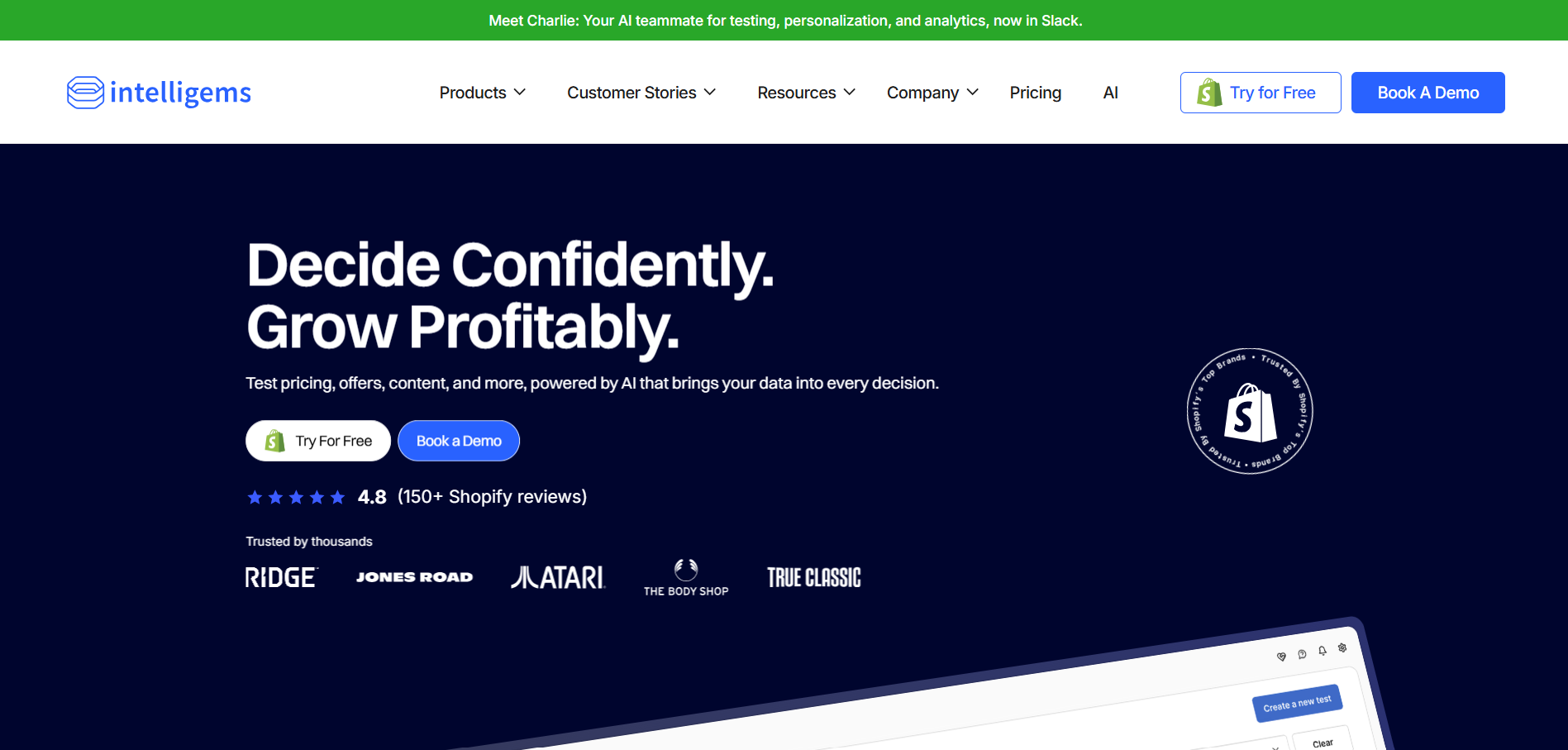
Intelligems
Intelligems is the tool we recommend most across our client stack. It's purpose-built for ecommerce experimentation, with strong Shopify Plus integration, native price and shipping testing capabilities that most general-purpose tools don't offer, and pricing that's accessible to 8-figure brands without crossing into enterprise territory.
If you're serious about testing as a discipline rather than a one-off project, Intelligems is the starting point.
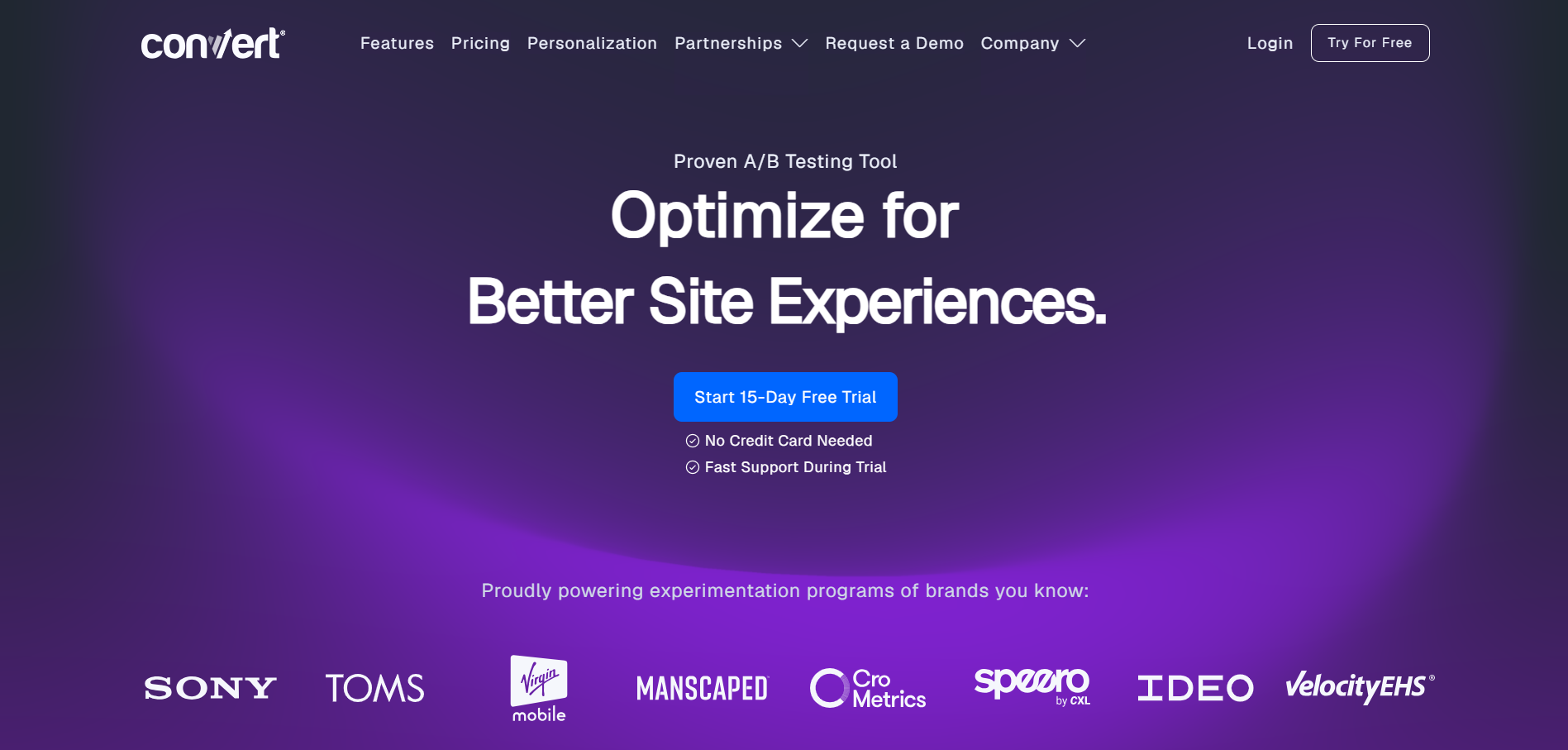
Convert
Convert is a solid tool for brands that are serious about testing but not yet at Optimizely scale. It's straightforward to install on Shopify and other ecommerce platforms, supports A/B and multivariate tests, and includes personalization. Pricing is transparent and starts well below Optimizely's floor. Their support team is genuinely responsive, which is a meaningful operational advantage when you're moving fast.
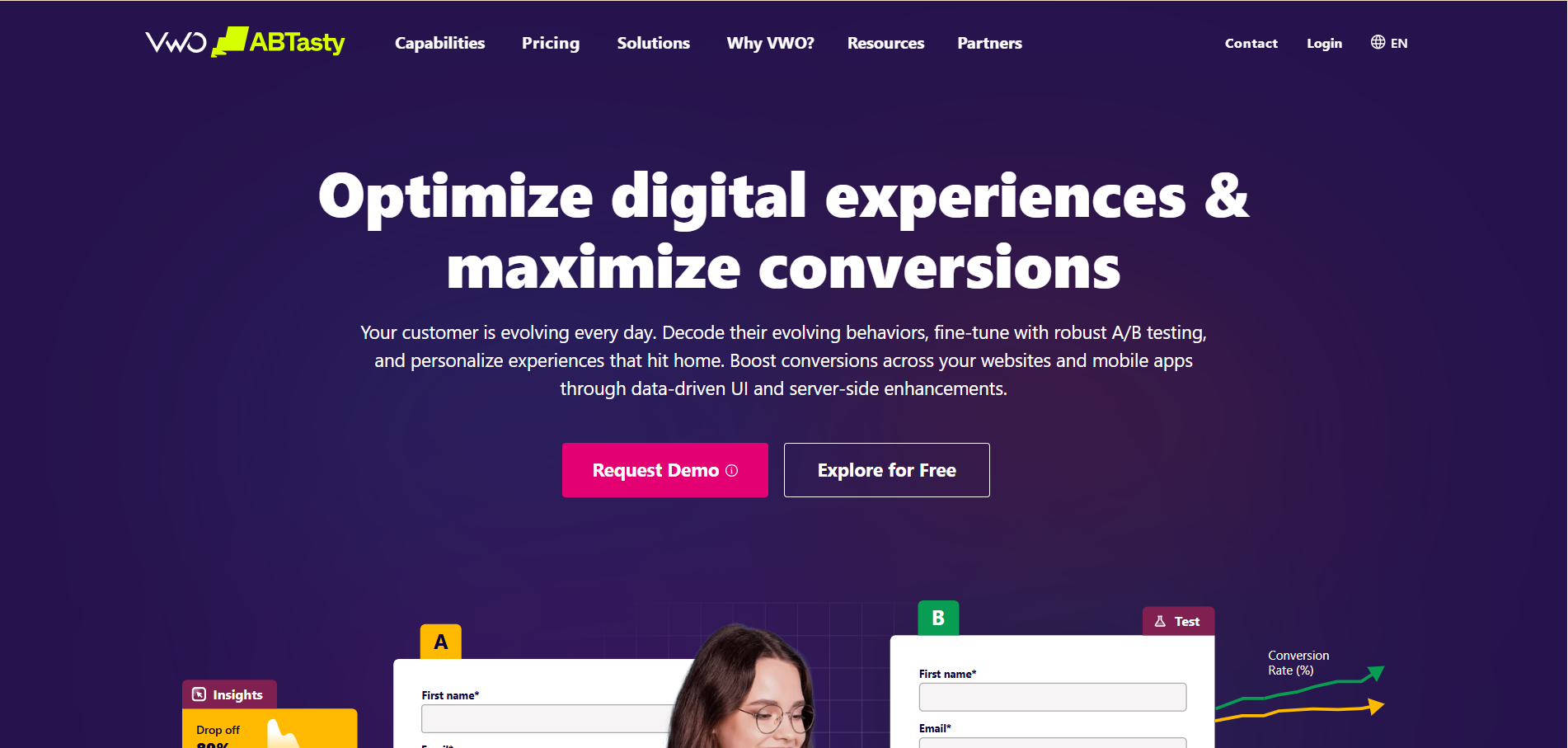
VWO (Visual Website Optimizer)
VWO has matured into a genuine all-in-one option. It now covers A/B testing, session recordings, heatmaps, and a dedicated personalization module under one platform. For mid-market ecommerce brands that want a consolidated stack without enterprise pricing, VWO is worth a direct evaluation. Pricing scales by monthly tracked users and is available without a sales call for most tiers.
What Most Brands Get Wrong About Choosing a Testing Tool
The tool decision gets made before the process is in place, and that's backwards. A disciplined experimentation process (clear hypotheses, proper statistical rigor, structured post-test analysis) will outperform a premium tool run without one, every time.
Haute Hijab, working with SplitBase, increased revenue per user by 18% and site-wide conversions by 26.8%. The tool matters less than the methodology behind it.
"With SplitBase... Our new initiatives are based on research, data and educated insights. We've increased RPU by 18% and site-wide conversions by 26.8%." — Alice Millard, Haute Hijab
Before you evaluate any tool, define your testing velocity target, your team structure, and your minimum acceptable ROI threshold. Then match the tool to those constraints, not the other way around.
How to Know If You're Ready for Optimizely
You're a candidate for Optimizely if all of the following are true:
Your site gets 250,000+ monthly unique visitors
You're running or planning to run 5+ concurrent experiments
You have a dedicated optimization team or agency managing the program
You have a personalization strategy with defined audience segments and content variants
Your annual CRO budget (tool plus people) exceeds $500,000
If two or more of those aren't true yet, start with Intelligems or Convert, build the process, and revisit Optimizely when the volume justifies it.
If you want to get serious with conversion optimization, need help with finding what to test, or need help with creating, running and analyzing your experiments, we help lifestyle, fashion and luxury ecommerce sites, such as Kiehl’s, Mackage and Yves Saint Laurent increase ecommerce sales by millions. Learn more about our conversion optimization services here, or request a free proposal here.
Frequently Asked Questions
How does Optimizely compare to Intelligems for ecommerce specifically?
Optimizely is built for enterprise-scale, general-purpose experimentation across any web property. Intelligems is built specifically for ecommerce testing, particularly the price testing, shipping testing, and merchandising experimentation that ecommerce brands actually run. For 8-9 figure DTC brands, Intelligems typically delivers more ecommerce-specific functionality per dollar, which is why we recommend it as the default starting point. Optimizely becomes the right tool when you've outgrown what Intelligems offers and need enterprise-grade personalization or cross-platform experimentation infrastructure.
Should we consider Optimizely if we're spending less than $150K annually on CRO?
Probably not. At total CRO budgets below $150K (tool plus people), the tool cost eats too much of the budget and leaves too little for the research, design, development, and analysis work that actually generates results. If you're below that threshold, Convert or Intelligems will deliver the testing capability you need, and you can revisit Optimizely when the program has grown enough to justify the upgrade.
How does the tool decision interact with the agency vs. in-house question at 8-9 figure scale?
The two decisions are linked. At 8-9 figure scale, most brands run a hybrid model: internal CRO capacity for execution, and an agency for research, methodology, and the strategic testing roadmap. The tool decision sits underneath that operational structure, and an agency partner brings cross-client expertise on which tools work best for which use cases, which is often more valuable than the tool choice itself.
How should the testing platform decision integrate with the broader CRO program?
The testing platform is infrastructure underneath the program, not the other way around. Define your testing velocity, team structure, ROI threshold, and research methodology first, then pick the tool that fits. We cover the full operational sequence in [the A/B Testing Process article].
What's the realistic timeline from selecting a testing platform to producing meaningful results?
Implementation and integration typically take 4-8 weeks depending on the platform and the complexity of your existing stack. The first 2-3 tests usually launch within the first quarter.
Compounding results (where the testing program produces a learning library that informs increasingly higher-leverage tests) typically become visible at the 6-month mark and compound significantly through 12-18 months. Brands that expect immediate results from a new testing platform are misunderstanding what the platform actually does: it enables a process, it doesn't replace one.
Does Optimizely's pricing scale with site traffic, or with the testing program complexity?
Both. Traffic is a direct pricing lever, and program complexity (number of concurrent experiments, depth of personalization, integration requirements, server-side experimentation) is the second axis. Most 8-9 figure DTC brands hit the traffic threshold but vary widely on program complexity. Brands at lower complexity end up paying for capability they don't use, while brands at higher complexity find the pricing more justifiable per test.
What's the alternative if Optimizely is over budget but we need more capability than Convert or VWO offer?
Intelligems is typically the right step up. It gives you more ecommerce-specific functionality than the mid-market generalist tools without crossing into Optimizely's enterprise pricing tier. If your team has engineering resources and specifically needs server-side experimentation, Statsig handles that at a fraction of Optimizely Full Stack's cost.
What metrics should we expect a testing platform to produce, and what should we measure separately?
The platform produces test-level statistics (variation performance, statistical significance, lift confidence intervals). Everything else, like program-level metrics such as test velocity, win rate, cumulative lift over time, and revenue impact attribution, should be measured separately in your broader analytics stack. Platforms that try to be both the testing tool and the program-level dashboard typically do neither well. Use the testing platform for what it's designed for, and build program-level visibility separately.





.png)