Most teams run split tests that go nowhere. They swap button colors, try a different headline, chase tactics from a "101 Things to Test" blog post, and hope something sticks.
You'd probably agree from firsthand experience that none of it moves the needle, and the reason is almost always the same: there's no conversion research behind it.
Conversion research is the work of figuring out why your specific customers buy, hesitate, or leave, so your tests are built on evidence instead of guesses. After 10+ years of running tests across 8- and 9-figure DTC brands, we've found that the most common cause of a mediocre conversion rate is a lack of it. Not a lack of traffic, not a lack of tools, and not a lack of ideas. A lack of understanding of what your customers think, feel, and need.
In this post, you'll learn the six conversion research methods we use to drive conversion lift for ecommerce brands, including the specific questions, frameworks, and extraction techniques that turn customer insight into revenue.
What conversion research is, and what you do with the findings
Conversion research is the process of gathering qualitative and quantitative evidence about your customers so you know what to test and why, instead of guessing. It's the gap between "let's try a green button" and "our checkout copy confuses people about whether this is a subscription, so let's test clearer language."
For an ecommerce brand, conversion research pulls from three kinds of data:
Behavioral data (the what and where): analytics, heatmaps, scroll maps, and session recordings that show where visitors drop off and what correlates with a sale.
Voice-of-customer data (the why): post-purchase surveys, on-site polls, customer interviews, and reviews that surface the language, motivations, and objections behind the behavior.
Usability and technical friction (the blockers): broken checkout flows, confusing navigation, and slow loads that quietly cost you orders.
The output isn't a report that sits in a drive. It's a ranked list of testable hypotheses, each one tied to a specific page element and a specific customer objection. That's what the six methods below are built to produce, and the framework that organizes them comes next.
The 3Ps Framework: why most ecommerce conversion research fails
Borrowed winners from other brands are basically lottery tickets, and the reason is context. Every ecommerce brand has a unique combination of Patterns, Proof, and Perception. We call this the 3Ps Framework, and it's the backbone of how we run conversion research, because it's why generic best practices consistently underperform.
When you copy a case study or implement a tactic from someone else's test, you're applying someone else's solution to someone else's 3Ps. It rarely fits. Almost 9 times out of 10, a page built on real customer research beats one built on best practices alone.
Patterns: the research phase, where most insight originates
Patterns break down into three layers, and each layer maps to one of the data sources above.
Behavioral patterns are the quantitative "what" and "where." This is your analytics, your heatmaps, your scroll maps. You're looking at what correlates with a sale versus what correlates with abandonment. The critical question is whether a pattern affects the majority of your customers or just a sliver, because that determines whether it's worth testing.
Voice patterns are the qualitative "why." This is the human reason behind the behavior, surfaced through post-purchase surveys, customer interviews, and the actual language your buyers use. When someone writes, "I almost didn't buy because I couldn't tell if it would work for my skin type," that's a voice pattern pointing straight at a testable hypothesis.
Resistance patterns are the usability and technical friction sitting underneath everything else. Broken checkout flows, confusing navigation, and slow page loads. These are structural problems, not emotional ones, and they need to be identified separately because the fix is usually engineering, not copy.
Proof: testing as a feedback loop
We think of testing as research in its true form, not a final verdict on what works. Every test generates its own learnings, and those learnings feed the next round of research and the next test after that. A "losing" test that reveals why visitors aren't responding to a particular message is just as valuable as a winner, because it sharpens your next hypothesis.
This is why the 3Ps are cyclical. Research feeds testing, testing generates new research. Over and over again.
Perception: the strategic filter
Perception is how your brand is positioned in your prospects' minds relative to the competition. What narrative anchors your positioning? Does your site build enough trust to close the sale?
This layer matters because it filters which Pattern-stage opportunities are worth pursuing. You might find a dozen potential tests from your behavioral and voice data, but Perception is what tells you which ones align with your brand strategy, not just your conversion mechanics. Without it, you're optimizing pages in a vacuum.
The six methods below map directly to these three layers, and they're how you fill each layer with real data rather than assumptions.
Method 1: Post-purchase qualitative surveys
This is the method we run more than any other, and it works because it captures customer language in its rawest, most useful form. Not multiple-choice, not NPS. Fully open-ended questions that reach people at the moment of highest engagement: right after they've decided to buy. That decision is fresh, their reasoning is accessible, and they're willing to share it.
The key distinction here is qualitative over quantitative. Multiple-choice surveys force customers into your framework. Open-ended questions reveal the language, motivations, and objections you'd never think to include in preset options.
The 4 questions that surface the best test ideas
After running hundreds of post-purchase surveys across DTC brands, these four open-ended questions consistently produce the most actionable insights:
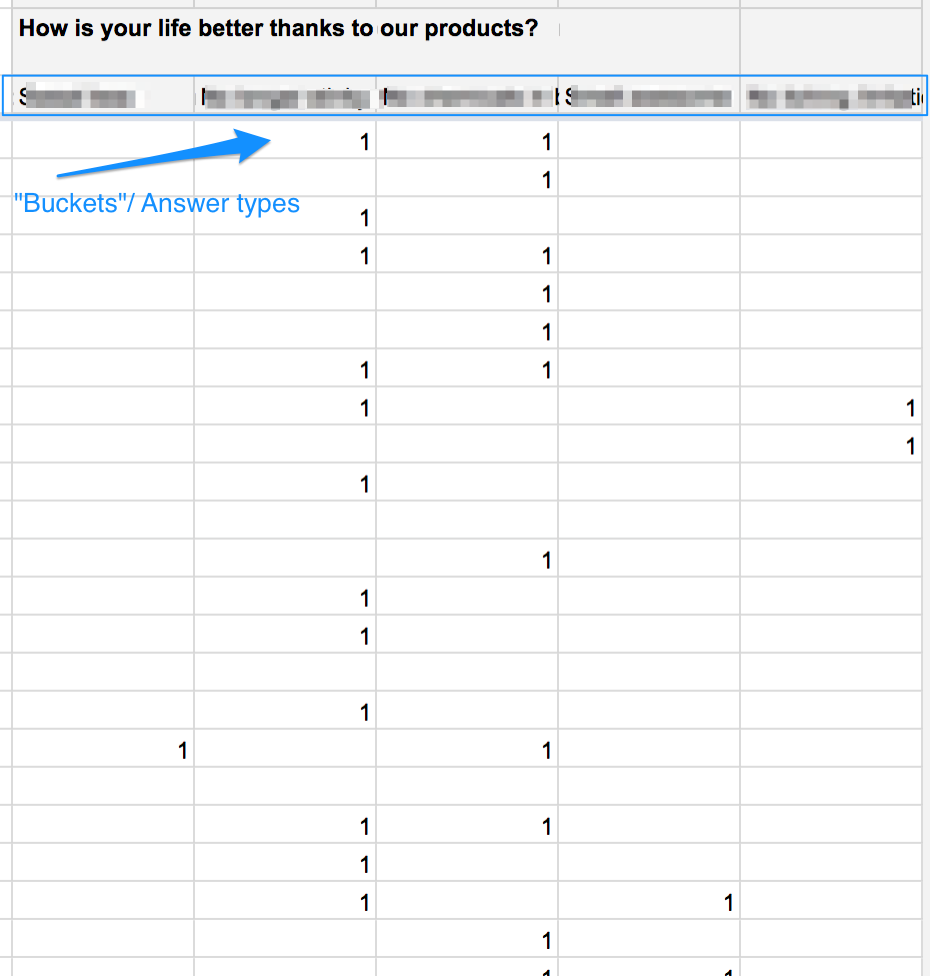
How did the product make your life better? Selling an outcome is way better than selling features, and this question uncovers the end benefit your customers are really after.
What made you decide to buy from us? Surfaces the real purchase trigger, not the assumed one.
What hesitations did you have before buying? Reveals the friction your analytics can't explain.
What ad or message first caught your attention? (Pulled from ad performance data.) This connects your off-site messaging to on-site behavior so your landing pages match the promise that brought visitors in.
When you see the same themes repeated five to seven times across responses, you have enough signal to build a test hypothesis. With 20 to 30 responses using these four questions, you'll typically surface two to three high-confidence test ideas.
How survey language becomes landing page copy
The highest-converting copy isn't written by copywriters. It's excavated from customer responses. When a customer writes, "I was nervous about the sizing, but the chart made it easy," that's a headline. When they write "I'd been looking for something like this for years," that's an ad angle.
After you codify your survey responses into buckets, pull the exact phrases that appear most frequently and map them to specific page elements. The language customers use to describe their hesitations belongs in your objection-handling copy. The language they use to describe the outcome they wanted belongs in your above-the-fold headline.
This is how research directly becomes revenue.
Method 2: Review mining for emotional language
Reviews are where emotional language lives, and emotions are roughly twice as powerful as logic in purchase decisions. Review mining isn't sentiment analysis. You're not looking for positive or negative scores. You're looking for the specific words and phrases customers use when they're emotionally activated: the moment they realized the product worked, the fear they had before buying, the exact outcome they were hoping for.
That emotional language, used verbatim in your copy, converts at a fundamentally different rate than language written by your marketing team.
Where to mine: your site, Amazon, and Reddit
Start with your own product reviews because they're the most targeted. Then expand outward to category-level sources where your customers are already talking without any brand filter applied.
Your own reviews give you the highest relevance, but the volume is limited for newer products.
Amazon is where you go for scale. The review volume is enormous, and the language is unfiltered. Look especially at three-star reviews, because they contain the most nuanced mix of praise and frustration, which is where the richest copy angles hide.
Reddit threads in relevant subreddits surface the language your customers use when they're not talking to a brand. This is where you find the real objections, the comparison language, and the emotional stakes of the purchase decision.
How to extract high-converting copy from reviews
The extraction process is straightforward but requires discipline. Read through reviews and highlight any phrase that describes a feeling, a fear, a transformation, or a specific outcome. Don't paraphrase. Copy the exact words. Then group similar phrases into themes and count frequency.
The phrases that appear most often across the most emotionally charged reviews are your highest-priority copy candidates. Test them as headlines, bullet points, testimonial callouts, and ad hooks. The goal is to make a prospect feel like you're reading their mind, because you literally are.
Method 3: Pre-purchase website polls
Post-purchase surveys only talk to buyers. Polls capture objections from people who didn't convert, and that's the critical gap most research programs miss entirely. Your buyers can tell you why they bought, but your non-buyers can tell you why they didn't, and only polls give you access to that second group.
Polls are micro-surveys deployed at specific moments in the browsing journey. They're non-intrusive, fast to answer, and, when targeted correctly, they generate insights that no other method can replicate.
A poll that led to a 23% increase in orders
One of our clients ran a PPC campaign that drove visitors to a detailed landing page. Most visitors read the whole page and scrolled all the way down to the buy button. With visitors now being aware of the price, you'd think the checkout process should convert well.
But when we looked at the analytics, over 50% of people dropped off at the first step of checkout.
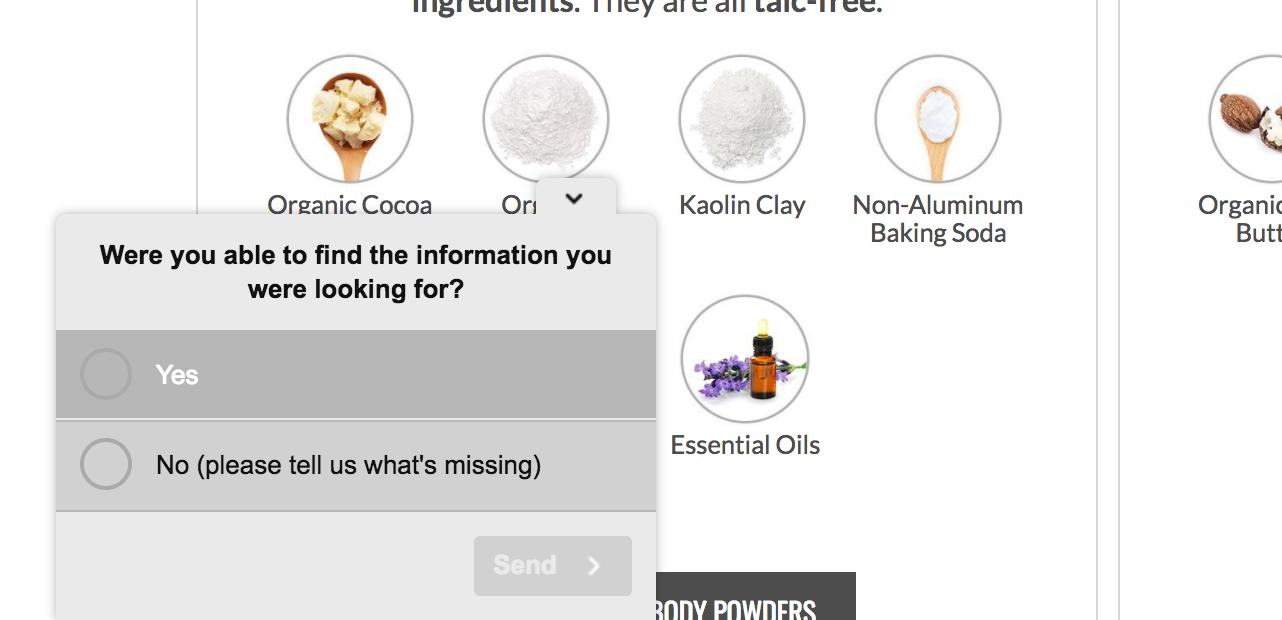
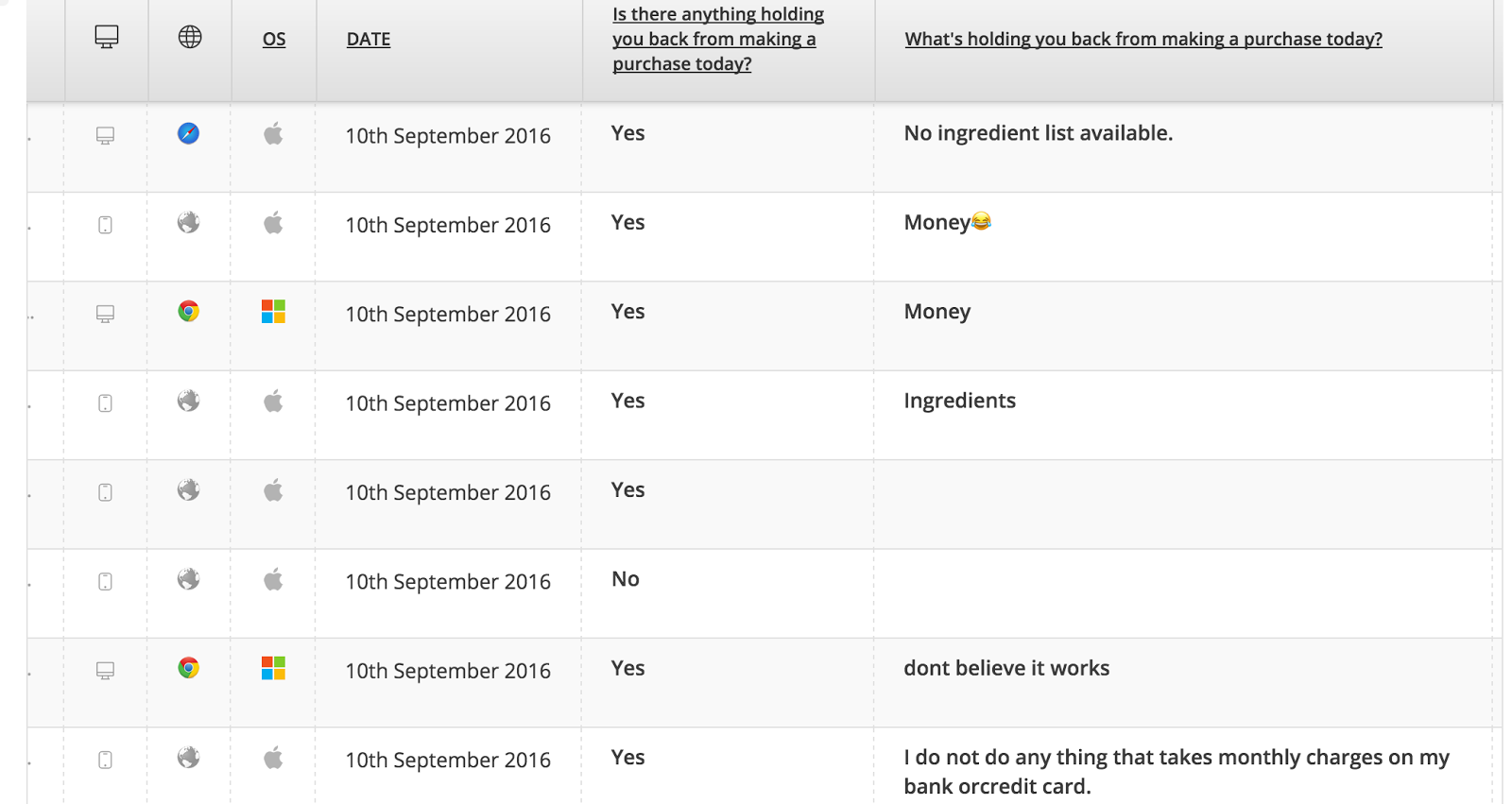
We launched a poll on that step asking visitors, "Is there anything holding you back from making a purchase?" If they answered "Yes," we asked, "What's holding you back?"
Over a few hours, we accumulated more than 500 responses. After carefully reading and analyzing every single response, we found the main issue: a lack of clarity in the copy. Visitors were confused about whether their order was a one-time purchase or a monthly subscription (when in fact, both options were available).
We formulated a hypothesis, launched A/B test variations, and after three weeks, one of our variations led to a 23% increase in orders. All from a quick poll that we manually analyzed and codified.
The Yes/No trick that boosts poll response rates
The most valuable poll question we use on product detail pages is simple: "What's holding you back from purchasing today?" But typing an answer feels like a commitment. So we preface it with a Yes/No question: "Is there anything holding you back from buying?"
If the visitor clicks No, the poll disappears. If they click Yes, the open-ended question appears. The Yes/No answer itself doesn't matter at all, because it's not an insight. But it reduces the perceived effort, and once someone clicks Yes, they're already engaged enough to type a response.
Poll placement and targeting that works
Poll targeting determines the quality of your data. Segment by behavior, not just by page. Show checkout polls only to visitors who have been on the page for more than 30 seconds, because they're engaged enough to have formed an opinion. Show PDP polls to visitors who have scrolled past the fold but haven't added to cart.
Keep polls to one or two questions at most. The moment a poll feels like a survey, completion rates collapse. Your goal is a single, high-signal answer that points directly at a testable friction point.
One good poll response that says "I couldn't figure out if this would work for my skin type" is worth more than 500 NPS scores.
Method 4: Customer interviews for journey mapping
One 30-minute call often surfaces a positioning angle that ten surveys would miss. Interviews are the highest-bandwidth research method available because they let you follow threads, ask follow-up questions, and observe emotional reactions in real time. They're also the most time-intensive, which is why most brands skip them. That's a significant competitive advantage for the brands that don't.
The goal of a customer interview in a CRO context is to map the full decision journey: what triggered the search, what alternatives were considered, what almost stopped the purchase, and what finally tipped the decision. You're not there to validate what you already believe.
When interviews beat surveys
Interviews outperform surveys in three specific situations. First, when you need to understand a complex purchase journey with multiple touchpoints and a long consideration period. Second, when survey responses give you themes but not enough context to build a confident hypothesis. Third, when you're entering a new product category and don't yet know what questions to ask.
The 30-minute framework
Structure your 30 minutes around four phases.
Spend the first five minutes on context: who they are, what they were trying to solve, and what triggered the search.
Spend the next ten minutes on the consideration journey: what alternatives they looked at, how they compared options, and what almost made them choose differently.
Spend ten minutes on the purchase moment: what finally tipped the decision and what objections they had to overcome.
Close with five minutes on outcome: how the product has performed against their expectations.
Record every call and have it transcribed verbatim. The copy value is in the exact words, not your summary. As you review transcripts, highlight any phrase that could function as a headline, an objection handler, or a proof point.
Watch out for confirmation bias
A few years ago, I was doing phone interviews to validate ideas for a company I was building. Instead of hearing the warning signs from my interviewees, I was only paying attention to the positive things they were saying. Subconsciously, I only remembered the things that validated my hypotheses. Without realizing it, I was convinced people were telling me they needed the product I was building, when in reality, they were saying the exact opposite.
This is confirmation bias, and it happens subconsciously. Here's a trick: focus on the opposite of what you want to believe is true. Find reasons why your hypothesis could be false. That discipline is the difference between research that moves you forward and research that keeps you going in the wrong direction.
Method 5: Behavioral analytics and revenue heatmaps
Surveys tell you why, and analytics tell you what and where, but you need to look at revenue per click rather than raw clicks. This distinction is the difference between optimizing for activity and optimizing for revenue. An element that gets 200 clicks but generates zero purchases is not valuable real estate, while an element that gets 15 clicks but generates $8,000 in revenue is your most important page asset.
Standard heatmaps show you where attention goes, but revenue heatmaps show you where value lives. When you combine behavioral data with revenue attribution, your prioritization decisions become dramatically sharper.
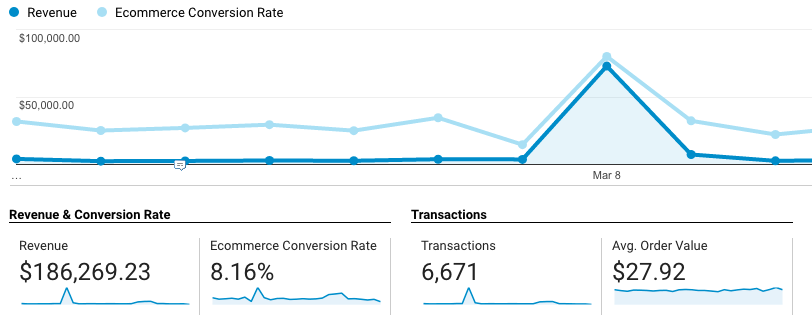
Averages and percentages can hide the truth behind your numbers. A single spike will increase your averages and mask the real story.
Why revenue per click beats raw clicks every time
When you evaluate page elements by revenue per click rather than click volume, your testing priorities shift. Navigation elements that get high click volume but low purchase correlation move down the list. Product recommendation modules that get modest clicks but high purchase rates move to the top.
Apply this lens to your above-the-fold content, CTA buttons, trust signals, and product imagery. For each element, ask: of the people who interact with this, what percentage purchase, and what is the average order value? That calculation tells you where a 10% improvement would have the greatest revenue impact, and that's where you should run your next test.
Method 6: Competitive perception research
Positioning tests often outperform UI tweaks by a factor of 10, but only when they're based on real perception gaps. This is the Perception layer of the 3Ps in action, and it's what keeps your optimization tied to brand strategy instead of just conversion mechanics.
The mistake most brands make is running competitive research to copy competitor features or design patterns. The right goal is understanding how your prospects perceive the difference between you and the three to five alternatives they're comparing you to. That perception gap (the space between how you think you're positioned and how prospects perceive you) is where your highest-leverage tests live.
Understanding your trust gap
Every brand has a trust gap: the distance between the trust level required to purchase and the trust level your site currently communicates. For most ecommerce brands, this gap is larger than they realize, and it's almost never solved by adding more trust badges.
To identify your trust gap, start with your customer interviews and survey responses. What did customers say they were worried about before buying? What made them finally feel confident enough to purchase? The answers reveal which trust signals matter to your specific audience, and those are often very different from the generic social proof and security badges that every competitor shows.
Why positioning tests beat UI tweaks
A positioning test changes what you claim and how you frame your value relative to alternatives. A UI tweak changes where a button sits or what color it is. Both are valid, but they operate at very different levels.
When your research reveals that prospects are comparing you to a specific competitor on a specific dimension (price, quality, speed, safety), a positioning test that directly addresses that comparison will almost always outperform any layout or button change you could make.
Build your positioning tests from the exact language your customers used when describing why they chose you over alternatives. If three customers independently said something like "I chose you because I trusted the ingredients more," that's a positioning angle worth testing prominently across your headline, hero section, and ad creative.
How to codify what you collect
Most of the methods above generate open-ended, qualitative responses that need to be analyzed before they're useful. Simply reading through them isn't enough, because confirmation bias will make you pay more attention to the responses that confirm what you already believe. You need a system.
We use a codification methodology that turns qualitative data into something actionable. After reading through all responses for a question, you create "buckets" of similar themes. Then you re-read every response and assign each one to a bucket, tallying as you go.
The bucket with the highest count is your top priority, not the bucket that felt most interesting when you read a single compelling response. This is what separates data-informed optimization from gut-driven guesswork.
For example, if you surveyed customers of an online skincare brand and asked "What nearly stopped you from buying?", you might end up with buckets like "unsure about ingredients," "shipping cost concern," "skeptical of results claims," and "couldn't find the right product for my skin type." Counting the frequency of each bucket tells you exactly which objection to address first on your product pages and landing pages.
What to test first, based on what your research found
Once you've codified your research, your testing order writes itself: start with the highest-frequency objection that sits on your highest-traffic page. You don't test the idea that felt most interesting. You test the one the most customers told you about.
Here's the sequence we follow:
Rank your codified buckets by count. The bucket with the most mentions is your first test, not the one tied to the most compelling single quote.
Map that objection to the page element that owns it. A sizing worry belongs on the PDP near the buy box. A subscription-versus-one-time confusion belongs at the first step of checkout.
Write the variation in your customers' words. Pull the exact phrases from your survey and review buckets and put them where the objection lives.
Check you have the traffic to call it. If the page can't reach significance in three to four weeks, move the test to a higher-traffic template or batch the change with a related one.
Run that loop on your top two or three objections before you touch anything cosmetic. The button color can wait until the page answers the questions your research says people are asking.
Measuring impact: track every insight to a revenue outcome
Every insight should be traceable to a test, and every test should be traceable to a revenue outcome. Without this tracking discipline, you can't tell which research methods generate the most value for your brand, and you can't justify continued investment in the ones that work.
Build a simple research-to-revenue tracking document with four columns: the research method that surfaced the insight, the insight itself, the test it generated, and the revenue impact of that test. After 10 to 15 tests, patterns will emerge showing which methods consistently drive winning tests for your specific brand.
The brands that compound their CRO results year over year treat research as an ongoing investment, not a one-time project. And the calculation that makes it non-negotiable is simpler than you'd think: compare the cost of the research (staff time, tool costs, incentives) against the annualized revenue value of the conversion lifts it generated. That ratio should improve as your testing program matures.
What ties all six methods together
Do your own research on your own brand. That's the thread that runs through every method above.
Borrowed winners, the "this worked for Brand X, test it on yours" approach, are playing the lottery. Each brand has unique problems, audiences, products, emotions, and objections. The conversion research you do on your own customers, using the methods above, will consistently outperform any best-practices list you find on the internet.
Being "data-driven" is a trendy claim. Being data-informed, where your qualitative and quantitative research combine to tell you what to test and why, is what moves the needle.
Frequently asked questions
Which conversion research method should I start with if I can only do one?
Start with post-purchase qualitative surveys. They're low-cost, high-impact, and the customer language you capture immediately improves your copy. Four open-ended questions can transform your landing pages. When you see the same themes repeated five to seven times across responses, you have enough signal to build your first data-informed test.
Can I use AI to analyze qualitative research data?
AI can help with initial categorization, but the highest-converting copy comes from using customers' exact words. AI tends to sanitize the emotional language that drives conversions. Use it to sort and group responses into themes, but never let it rewrite or summarize the actual phrases. The raw language is the asset.
How do revenue heatmaps differ from regular heatmaps?
Regular heatmaps show where people click. Revenue heatmaps show which clicks lead to purchases and the dollar value of those purchases. An element might get 100 clicks but generate zero dollars, while another gets 10 clicks but generates $10,000. Optimizing based on click volume alone means you're improving engagement metrics, not revenue. Always tie behavioral data to purchase outcomes before making prioritization decisions.
How often should I refresh customer research?
Run major research initiatives quarterly, but keep post-purchase surveys running continuously. Market perceptions, competitor landscapes, and customer language all evolve, especially after major product launches or significant shifts in ad spend. Continuous surveys ensure you catch shifts in customer language before they become conversion problems.
What's the biggest mistake brands make in conversion research?
Asking leading questions or multiple-choice surveys that force customers into your framework. Open-ended questions reveal language and insights you'd never think to include in preset options. The moment you give customers a list of answers to choose from, you've stopped learning and started confirming your existing assumptions.
How do I know if my research is driving results?
Track every insight to its corresponding test. Document which research method surfaced the insight, what changes you made, and the revenue impact. After 10 to 15 tests, patterns emerge showing which methods drive the biggest wins for your brand. Without this tracking discipline, research feels like overhead. With it, research becomes the most measurable investment in your growth stack.




.png)
