Diagnose what’s holding back your ecommerce growth. Take the 3-min CRO Assessment →


Full-Business CRO Program
Conversion Website Redesign
"SplitBase had been our CRO partner for over a year when we decided to do a full rebuild with them. We chose to do this project with them because of their rigorous, data-driven approach to UX design and testing, and their highly process-driven approach to strategy, particularly the focus on deep user research."

Average CVR Increase
Subscription Rate Increase
Pagespeed Improvement
Transparent Labs is a premium sports nutrition DTC brand built on one promise: tell customers exactly what's in the products, at clinically effective doses, with nothing artificial.
That positioning sets a high bar for the digital experience. Premium supplements are bought on trust, and the website is where most of that trust gets built or lost.
By the time Joe Cornfield, the brand's CMO, brought SplitBase in, Transparent Labs was scaling paid acquisition significantly and running into the ceiling of what their existing site could support.
They'd run internal A/B tests in the past, but testing volume was low and the process wasn't formalized. They knew they were leaving wins on the table, they just didn't have the bandwidth or system to find them.
"We were investing heavily in growth and paid traffic, and we knew that web performance was our bottleneck. We talked to several agencies, and decided to work with SplitBase based on their highly process-driven approach to strategy, and analytical rigor when it came to testing and measurement."
- Joe Cornfield, CMO
There was a bigger structural problem too. Their Shopify theme had been built on an aging codebase, and over the years it had picked up layers of apps, patches, and inconsistent design decisions. It still worked. But it wasn't moving the brand forward, and every new initiative was getting slower and more expensive to ship.
Two problems stacked on top of each other:
→ A performance ceiling. Subscription take rate, AOV, and conversion rate all had room to grow.
→ A foundation problem. Even with a solid conversion optimization and A/B testing program, the site itself (speed, code, design system) was holding the brand back.
The CRO program would tackle the first. A full rebuild, eventually, would tackle the second.
And Transparent Labs didn't want to redesign on assumptions; they wanted to redesign on evidence.
.png)
Patterns, Perception, and Proof. The order matters. Each stage feeds the next, and skipping ahead is how brands end up testing the wrong things.
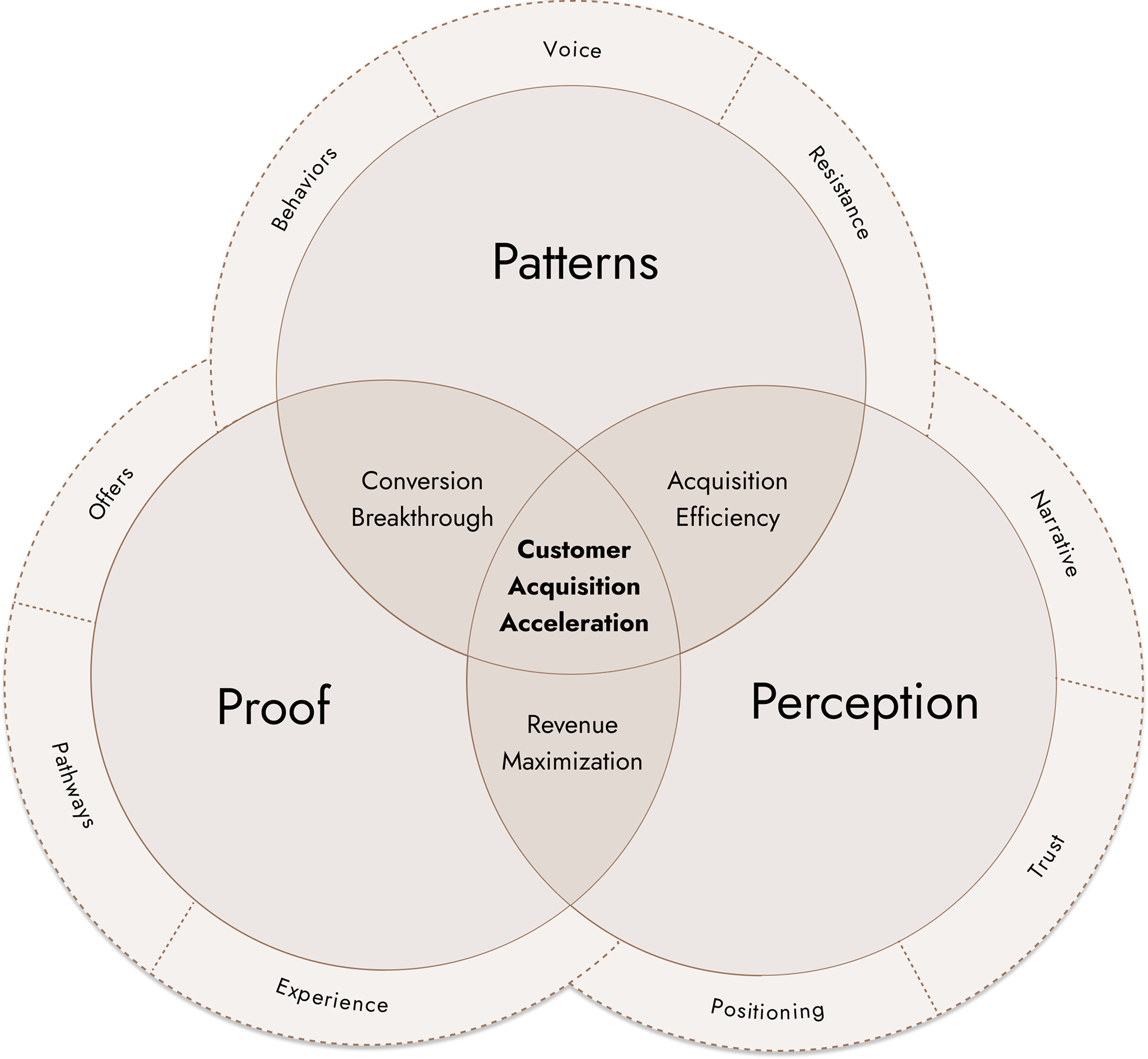
→ Patterns is the research stage. It has three layers running in parallel. Behavior patterns from GA4, funnel analysis, heatmaps, scroll maps, and session recordings tell you what is happening and where. Voice patterns from VoC surveys, polls, review mining, and support tickets tell you why. Resistance patterns are the friction points across the purchase path (technical, emotional, or strategic) and tell you what's blocking the buy.
→ Perception is the strategic filter. Before any pattern becomes a test, it gets run through the brand and competitive lens. What does the competitive landscape look like? How is the brand perceived versus competitors? What narrative does the positioning need to anchor? Does the brand build trust, and how? Optimization ideas that don't survive this filter get killed here.
It's the difference between optimizations that cheapen your brand to squeeze out a short-term lift, and optimizations that elevate your brand while it elevates performance.
→ Proof is the A/B test itself. Only what survives Patterns and Perception gets tested. Win or lose, every test teaches you something about your customers. A winning test tells you what to ship. A losing test tells you why your hypothesis was wrong, which is often as valuable. Both feed the next round of research and the next round of tests.
By following that process, we had our first A/B tests live within 2 weeks, and had produced a prioritized testing roadmap shortly after that, which allowed us to run tests with statistical power across their entire funnel.
"Their strategic insights were rooted in deep qualitative customer research, and as a result of our partnership we ended up learning more about our customer than we ever had in the past."
- Joe Cornfield, CMO
One of the tests we ran goes to the heart of what Transparent Labs is as a brand.
The company's premise is in its name. Clean labels, clinical doses, third-party lab verification on every product. On product pages, however, that evidence was buried in product descriptions and not visible to shoppers at the moment they were deciding whether to trust the brand enough to buy.
Patterns: Behavioral. PDP engagement data showed accordions were being used, but the most credible piece of evidence the brand had (third-party lab testing) wasn't sitting in one of them. It was buried elsewhere or missing from the PDP entirely.
Patterns: Voice. VoC research in the supplement category repeatedly reveals the same hesitation: shoppers have been burned by tons of brands before. They've read about proprietary blends, undisclosed dosing, and labels that don't match what's actually in the bottle. For a Transparent Labs shopper, "is this really clean?" was one of the dominant pre-purchase questions.
Perception. Third-party lab verification isn't just a trust signal for Transparent Labs. It's the brand's entire positioning. Surfacing it more prominently doesn't compete with the brand narrative. It is the brand narrative. Strategic alignment was maximal.
Proof. We added a "3rd Party Testing" section to the PDP with the relevant testing detail for each product.
.png)
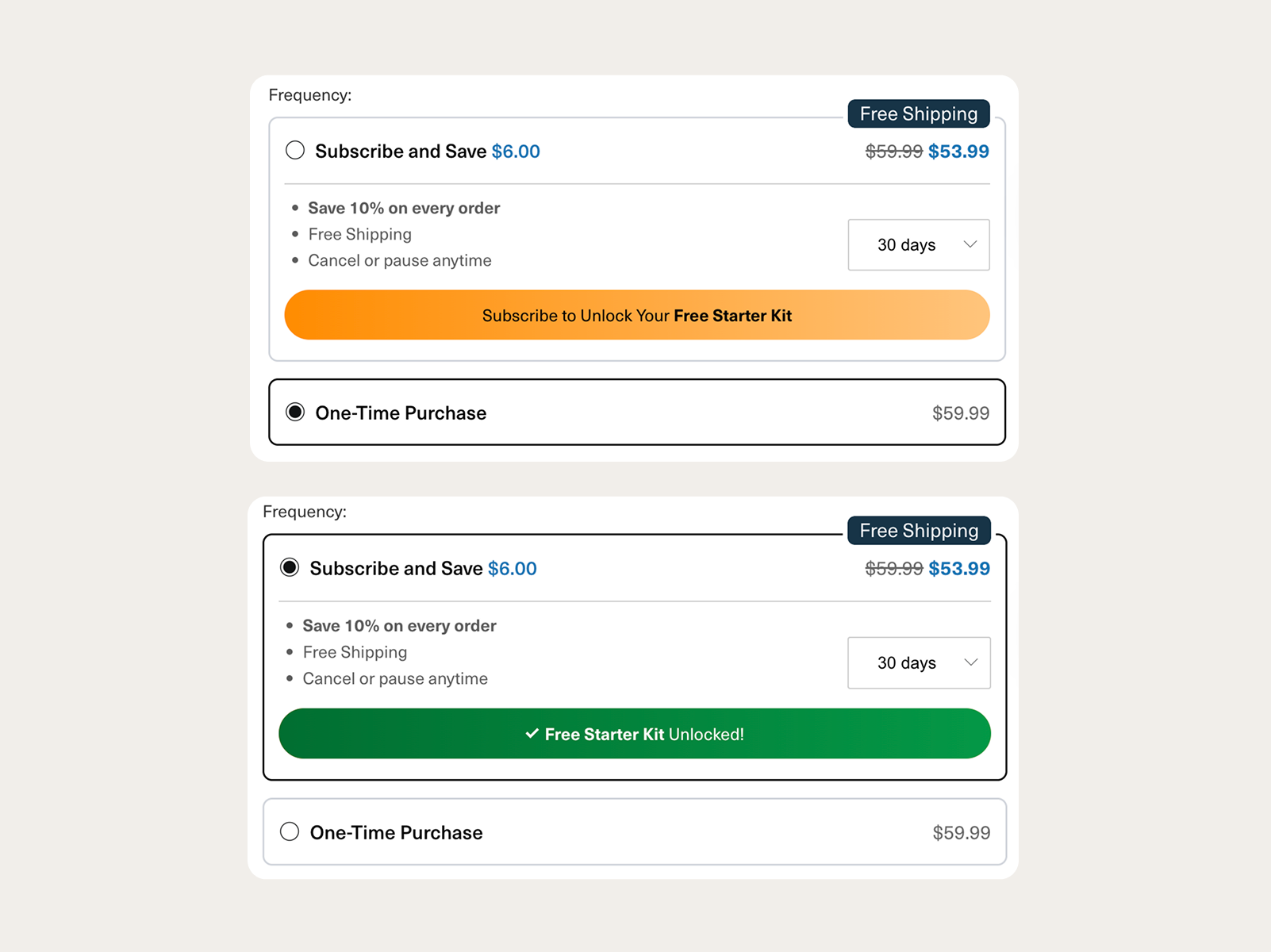
Given that increasing subscriptions was a focus area for the DTC brand, the testing program tested several iterative, substantial and disruptive tests that aimed to increase subscriptions and LTV, without negatively impacting conversion rates.
This led to several changes, tests, and iterations, including an interactive "Unlock a Free Starter Kit" animation that rewarded people the moment they selected the subscription option, turning a pricing decision into a small win.
A year of testing surfaced a hard truth no test could solve. Some of the constraints holding Transparent Labs back were baked into the foundation of the site itself.
"The old site had evolved in layers on top of an outdated codebase and there were a lot of app dependencies. This was a drag on site performance and made it tough to build on. We hadn't been rigorous enough with sticking to a design system, so the interface felt visually inconsistent."
- Joe Cornfield, CMO
There was a brand problem on top of the technical one. Transparent Labs sells premium, science-backed supplements. The old site didn't carry that perception with the weight it deserved. Trust, scientific authority, and brand polish were all under-delivered, and the team felt it every time a competitor's PDP looked sharper than theirs.
Transparent Labs made the decision that many brands hesitate to make. Rather than patch the existing site one more time, they invested in a full rebuild. And because SplitBase had been their CRO partner for over a year, the team chose to keep the work in-house at the agency rather than hand it to a traditional design shop.
The redesign was treated as a continuation of the CRO program, not a reset of it. Every major design and UX decision could be traced back to something we'd already learned about Transparent Labs' customers:
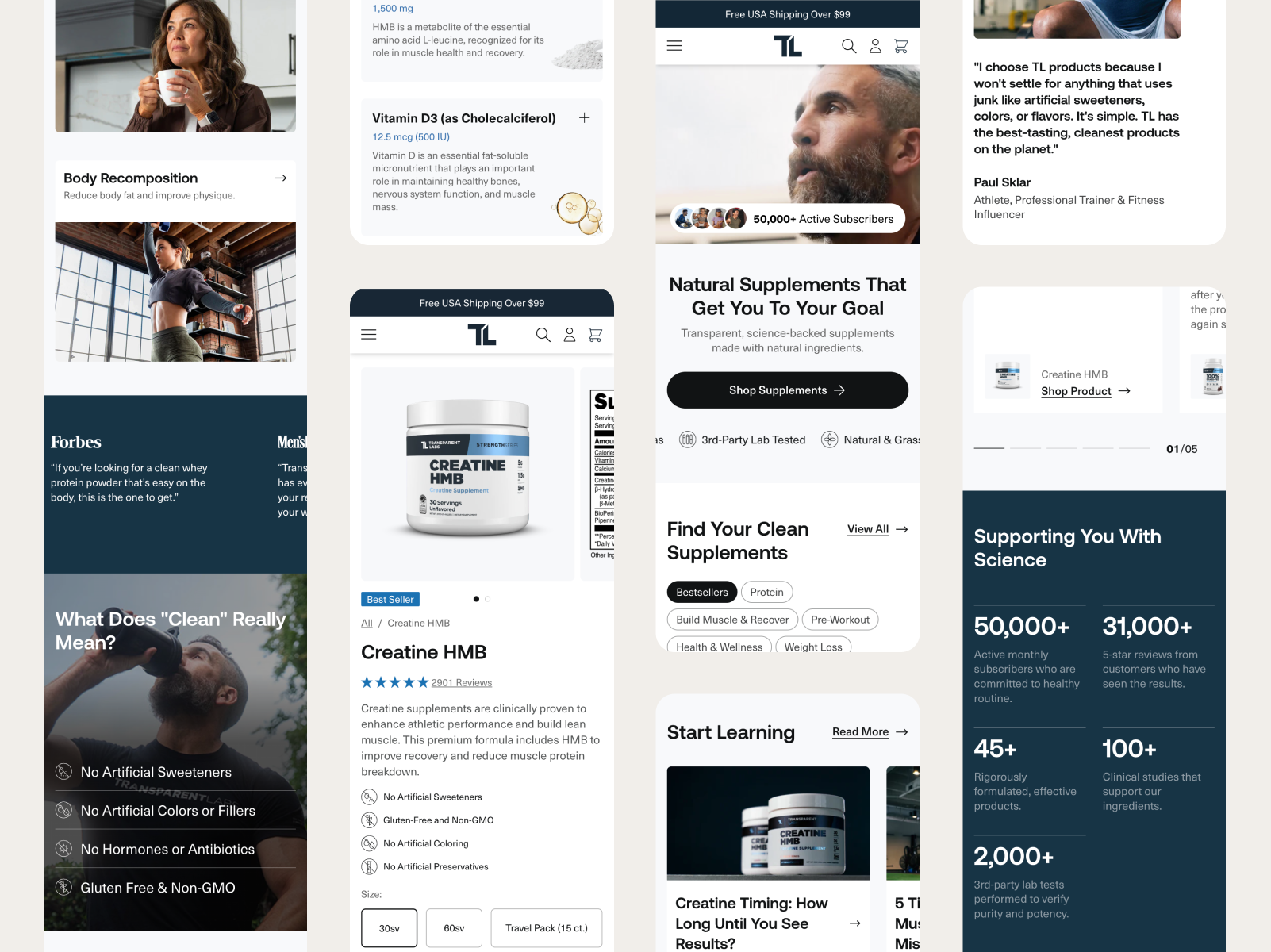
→ The buy-box that had won in testing became the foundation of the new PDP, not a feature bolted on.
→ The hero copy patterns that performed best across multiple tests informed the new homepage and category page architecture.
→ The credibility elements customers told us they needed (certificates of analysis, third-party testing, formulator credibility) were promoted into visual hierarchy, not buried in tabs.
On the technical side, the team rebuilt the theme on a new Horizon codebase, stripping out the app dependencies that had accumulated over years and replacing them with a clean, performance-first foundation. Pagespeed improved by over 40%.
The new design system was built to do what the old one couldn't: communicate, at a glance, that this is a premium brand worth trusting with your daily routine.
The CRO program and the redesign worked together, and that's how the results are best read. A year of testing followed by a rebuild grounded in that testing is what produced the numbers.
→ Average conversion rate improved by over 12% across the program, generating 7 figures in monthly revenue impact.
→ Subscription take rate grew from 22% to 38%+, driven primarily by subscription-specific tests and reinforced by how subscription is now presented on the rebuilt PDP.
→ Pagespeed improved by over 40%, a direct result of the new, clean rebuild and the removal of legacy app dependencies.
→ Scaled ad spend. With subscription economics and on-site performance both improving, the team had more confidence to push paid acquisition harder.
For Transparent Labs, the project produced two things that don't always come together.
The first is the obvious one. Conversion rate, subscription take rate, and site speed all moved in the right direction, and the website now genuinely supports the brand it represents.
"Improvements in subscription and overall site performance have allowed us to open up top of funnel budgets and invest more in growth."
- Joe Cornfield, CMO
The second is harder to put on a stat sheet but matters just as much. The internal team came out of the engagement with sharper instincts, better testing discipline, and a clearer view of their own customers than they had before.
This is why the redesign was never the risk it looked like on paper. A redesign only feels risky when it's disconnected from actual CRO strategy.
Increase your conversions and AOV too.
Request a free proposal.
%20(1).jpg)
Transparent Labs ran a year-long CRO program with SplitBase, then rebuilt the site on the evidence that program produced. Subscription take rate went from 22% to 38%+, average conversion rate improved by over 12%, and pages peed improved by over 40%.

Ancestral Supplements needed to level up paid social performance, and our landing page optimization program did just that.
